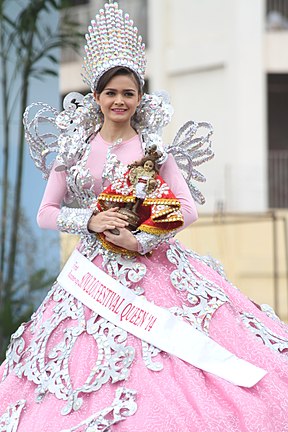
On March 16, 1521, the Portuguese explorer Ferdinand Magellan arrived and planted the cross on the shores of Cebu, claiming the territory for Spain. He presented the image of the Child Jesus to the Rajah, Humabon. Hara Humamay (or Amihan in some versions) was later named, Queen Juana in honor of Juana, mother of Carlos I. Along with the rulers of the island, some 800 natives were also baptized to the Roman Catholic Church. At the moment of receiving the holy image, it was said that Queen Juana danced with joy bearing this image of the child Jesus. With the other natives following her example, this moment was regarded as the first Sinulog.
This event is frequently used as basis for most Sinulog dances, which dramatize the coming of the Spaniards and the presentation of the Santo Niño to the Queen. A popular theme among Sinulog dances is Queen Juana holding the Santo Niño in her arms and using it to bless her people who were often afflicted with sickness believed to be caused by demons and other evil spirits.
The Sinulog dance steps are believed to originate from Rajah Humabon’s adviser, Baladhay. It was during Humabon’s grief when Baladhay fell sick. Humabon ordered his native tribe to bring Baladhay into a room where the Santo Niño was enthroned, along with the other pagan gods of the native Cebuanos. After a few days passed, Baladhay was heard shouting and was found dancing with utmost alertness. Baladhay was questioned as to why was he was awake and shouting. Pointing to the image of the Santo Niño, Baladhay explained that he had found on top of him a small child trying to wake him and tickling him with the midrib of the coconut. Greatly astonished, he scared the child away by shouting. The little child got up and started making fun of Baladhay. In turn, Baladhay danced with the little child and explained that he was dancing the movements of the river. To this day, the two-steps forward, one-step backward movement is still used by Santo Niño devotees who believe that it was the Santo Niño’s choice to have Baladhay dance.
 Cebu
Cebu 